




INTERPOL Diffusion Notice Lawyer
Our legal team provides expert defence against INTERPOL Diffusion Notices — from identifying whether a Diffusion has been issued to filing CCF requests, engaging National Central Bureaus, and preventing border detention. Contact us for a confidential consultation.

An INTERPOL Diffusion removal lawyer can help determine whether personal data relating to a Diffusion are being processed through INTERPOL, assess whether the information complies with INTERPOL’s rules and prepare a request for access, correction or deletion where the applicable procedure allows it.
Our lawyers advise individuals facing Wanted Person Diffusions, cross-border arrest risks and related extradition proceedings. We also assess whether urgent legal measures may be appropriate where travel, detention or additional INTERPOL circulation is a concern.
Specialist Legal Support Against Transnational Charges
Our dedicated international human rights lawyers uncover procedural violations and challenge abusive cross-border alerts. We build proactive defense strategies to safe-keep your personal data and protect your global freedom.
What Is an INTERPOL Diffusion?
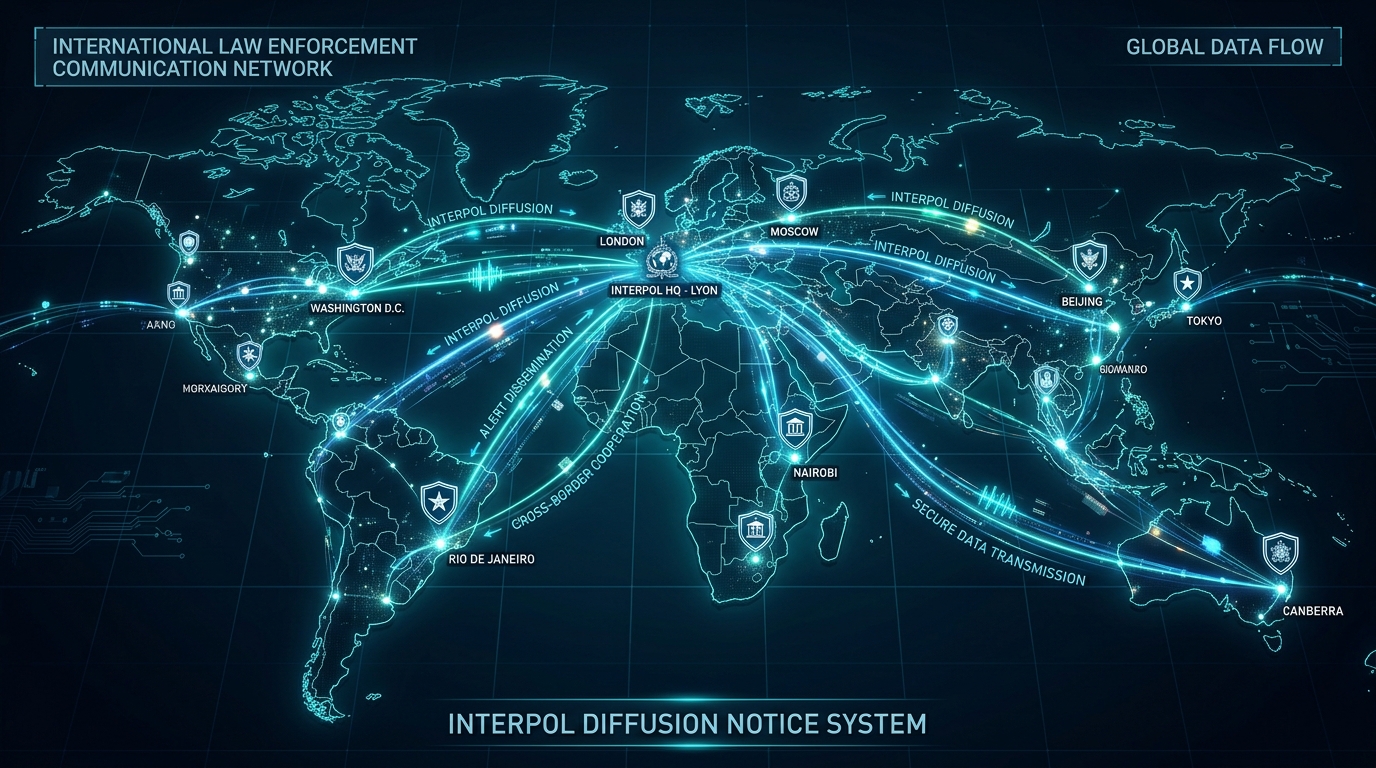
An INTERPOL Diffusion is a request for international police cooperation circulated directly by a member country’s National Central Bureau (NCB) to all or selected other member countries.
Diffusions correspond to INTERPOL’s colour-coded Notice system. They can therefore serve different purposes depending on their type. A Wanted Person Diffusion, sometimes described as a red diffusion, seeks cooperation concerning an accused or convicted person, including locating, arresting, detaining or restricting that person’s movement where national law permits.
Unlike a Notice, which INTERPOL’s General Secretariat publishes at the request of a member country, a Diffusion is circulated directly by the requesting NCB. However, this does not mean that Wanted Person Diffusions escape INTERPOL compliance controls. INTERPOL’s Notices and Diffusions Task Force reviews Wanted Person Diffusions for compliance with the Organization’s Constitution and Rules on the Processing of Data.
What Is a Wanted Person Diffusion?
A Wanted Person Diffusion concerns an individual who is accused or convicted of a criminal offence and whose location, arrest, detention or restriction of movement is sought internationally.
The requesting country remains responsible for the underlying criminal proceedings. INTERPOL itself does not determine guilt and does not issue an international arrest warrant.
The legal effect of a Wanted Person Diffusion also differs between countries. National authorities decide what action they may take under their own law and whether there is a sufficient domestic or extradition-related basis for arrest or detention.
This is important because the existence of an INTERPOL circulation does not, by itself, create a universal obligation to arrest a person.
How Does an INTERPOL Diffusion Differ From a Red Notice?
A Red Notice and a Wanted Person Diffusion can serve a similar international policing purpose, but they are circulated differently.
| Red Notice | Wanted Person Diffusion |
| Published by INTERPOL’s General Secretariat at the request of a member country | Circulated directly by an NCB |
| Normally alerts INTERPOL member countries broadly | Can be sent to all or selected member countries |
| Some Red Notices are available publicly | Diffusions are not published on INTERPOL’s public Red Notice list |
| Subject to INTERPOL Constitution and RPD | Also subject to INTERPOL Constitution and RPD |
| Reviewed for compliance | Wanted Person Diffusions are also reviewed for compliance |
Neither instrument is itself an international arrest warrant. National law determines what legal consequences follow in each country. INTERPOL likewise states that member countries decide what legal value they give to Red Notices and whether their authorities have power to arrest.
Can an INTERPOL Diffusion Lead to Arrest?
Potentially, yes.
A Wanted Person Diffusion can alert national authorities that another country seeks a person in connection with criminal proceedings. In some jurisdictions, the information may contribute to provisional arrest or detention pending an extradition request.
However, arrest is not automatic. Authorities must act according to the receiving country’s domestic law and the legal basis available in the particular case.
Relevant issues may include:
- whether a valid national or foreign arrest warrant exists;
- whether the alleged offence is extraditable;
- applicable extradition treaties or legislation;
- dual criminality requirements;
- the person’s nationality or immigration status;
- human-rights protections;
- other procedural requirements under national law.
For this reason, an INTERPOL Diffusion and an extradition case should be analysed as related but legally separate matters.
How Can You Fight an INTERPOL Diffusion?
There is no single procedure that applies identically to every Diffusion.
The correct strategy depends on what data are being processed, how the information was circulated, whether there is an underlying arrest warrant and whether proceedings are already taking place in a particular country.
Request Access to INTERPOL Data
Where there is reason to believe that INTERPOL holds personal data about an individual, a request for access can be submitted to the Commission for the Control of INTERPOL’s Files (CCF).
The CCF is an independent body responsible for reviewing the compliance of personal data processed in INTERPOL’s Information System.
Since 26 March 2026, requests for access, correction, deletion and revision must generally be submitted through the CCF’s dedicated online portal.
An access request can help establish whether relevant information is being processed through INTERPOL, although disclosure may be subject to restrictions under INTERPOL’s rules.
Request Correction or Deletion Through the CCF
Where personal data are processed in INTERPOL’s Information System, an applicant may ask the CCF to assess whether those data comply with INTERPOL’s rules.
The CCF can consider requests for correction or deletion and, where it finds data non-compliant, corrective measures can include correction or deletion by the General Secretariat.
There is, however, an important limitation following amendments approved in 2025. The CCF cannot ordinarily review information exchanged directly between NCBs outside its normal review scope unless a serious violation of INTERPOL’s rules is reported through the applicable mechanism.
For that reason, the first legal task is to identify the nature and location of the data rather than assume that every NCB communication can automatically be challenged through the CCF.
Address the Underlying National Proceedings
Removing or correcting data within INTERPOL does not automatically terminate the criminal case, arrest warrant or extradition proceedings in the requesting country.
Where appropriate, lawyers may therefore need to examine:
- the underlying criminal case;
- the validity or status of the arrest warrant;
- acquittals or discontinued proceedings;
- decisions refusing extradition;
- procedural developments in the requesting state;
- other national decisions that may affect the continued purpose or accuracy of the INTERPOL data.
Separate representation may also be required in the country responsible for the underlying proceedings.
Consider Preventive Action Where a New Alert Is Expected
Where there is a credible risk that a new Notice or Diffusion may be sought, legal counsel can assess whether information should be presented proactively to the relevant INTERPOL bodies or competent national authorities.
This may be particularly relevant where there is documented evidence of political persecution, refugee status, previous abusive use of international police cooperation or other circumstances directly relevant to compliance with INTERPOL’s rules.
Preventive action does not guarantee that INTERPOL will refuse future data, but it can ensure that relevant information is available for compliance assessment.

What Grounds Can Support Removal of an INTERPOL Diffusion?
The merits of any challenge depend on the individual case.
Possible compliance issues can include:
Political, military, religious or racial character.
Article 3 of INTERPOL’s Constitution strictly prohibits the Organization from undertaking activities of a political, military, religious or racial character. The Notices and Diffusions Task Force expressly considers Article 3 when reviewing Diffusions.
Human-rights concerns.
INTERPOL must act in the spirit of the Universal Declaration of Human Rights under Article 2 of its Constitution. Serious human-rights issues may therefore form part of a compliance assessment.
Inaccurate or outdated data.
Information may require review where important facts are incorrect, no longer current or contradicted by later judicial or procedural developments.
Lack of a continuing legitimate purpose.
Developments such as termination of proceedings, cancellation of an underlying warrant or other substantial changes may affect whether continued processing remains justified.
Insufficient basis for international police cooperation.
The seriousness of the alleged conduct, description of criminal activity and international policing purpose can also be relevant under INTERPOL’s data-processing framework.
An acquittal, settlement or national procedural defect does not automatically mean INTERPOL data must be deleted. The effect of each development has to be assessed under INTERPOL’s own rules.
How Can an INTERPOL Diffusion Removal Lawyer Help?
An INTERPOL Diffusion removal lawyer can assess both the INTERPOL dimension of the case and any connected national proceedings.
Legal assistance may include:
- reviewing the available information about the alleged Diffusion;
- preparing a CCF access request;
- analysing the data against INTERPOL’s Constitution and Rules on the Processing of Data;
- preparing a correction or deletion request where legally available;
- gathering national judgments, refugee decisions or other relevant documents;
- assessing arrest and extradition risks in relevant jurisdictions;
- coordinating with local counsel where national proceedings require separate action;
- advising on preventive measures where a new INTERPOL circulation is anticipated.
A CCF procedure concerns the processing of data through INTERPOL. The CCF does not decide whether an individual is guilty, invalidate national arrest warrants or determine the outcome of national extradition proceedings. INTERPOL expressly limits the CCF’s competence in this way.
Can You Apply for Revision After a CCF Decision?
Yes, but revision is not a parallel or ordinary second challenge.
A party may seek revision of a CCF decision only where new facts have been discovered that could have led the Commission to a different conclusion if they had been known during the original proceedings.
Those new elements must be submitted within six months after their discovery.
This means an Application for Revision normally becomes relevant only after an earlier CCF decision and the later emergence of qualifying new evidence.
How Long Does a CCF Request Take?
INTERPOL’s current rules distinguish between access requests and requests for correction or deletion.
The CCF generally decides:
- access requests within four months after the request becomes admissible;
- correction or deletion requests within nine months after admissibility.
Exceptional circumstances can extend the process.
For this reason, I would remove the old claim that a CCF case “typically takes 6 to 18 months.” The official statutory periods are a much better reference.
What Should You Do if You Suspect an INTERPOL Diffusion Exists?
If you believe a Diffusion may concern you, the appropriate next steps depend on the available evidence and your immediate risk.
Useful steps may include:
- determining whether INTERPOL processes personal data about you;
- identifying the requesting country;
- establishing whether an arrest warrant or criminal case exists;
- assessing upcoming travel or border risks;
- reviewing potential extradition exposure;
- gathering relevant judgments and procedural documents;
- considering whether a CCF request is available;
- obtaining advice in the requesting or receiving country where national proceedings are involved.
A search of INTERPOL’s public Red Notice database cannot establish that no Diffusion exists because Diffusions are not published through that public Red Notice list.
Contact an INTERPOL Diffusion Removal Lawyer
If you believe a Wanted Person Diffusion has been circulated against you, or you have already encountered border, arrest or extradition problems connected with INTERPOL data, early legal assessment can help identify which procedures are actually available.
Our lawyers can review the circumstances, assess whether a CCF request is appropriate and coordinate related cross-border legal issues where necessary.
Contact our legal team for a confidential case assessment.
Frequently Asked Questions
There is no universal travel ban created by an INTERPOL Diffusion. However, a Wanted Person Diffusion may become visible to law-enforcement or border authorities in countries to which it has been circulated. Depending on national law and the existence of an underlying arrest warrant or extradition request, travel may therefore create a risk of questioning, detention or other legal action. The risk should be assessed for the specific countries involved before international travel.
Potentially, yes. Recognised refugee status may be relevant where the INTERPOL data originate from the country from which the person was granted protection, particularly if the criminal proceedings are connected with the persecution underlying the refugee claim. However, refugee status does not automatically result in deletion of a Diffusion. The CCF assesses the circumstances of the case and the compliance of the data with INTERPOL’s Constitution and data-processing rules.