






INTERPOL is an international police cooperation organization, not a supranational police force. It does not investigate cases independently, issue national arrest warrants, conduct arrests, or order extradition. Instead, INTERPOL enables law-enforcement authorities in its 196 member countries to exchange police information and coordinate international cooperation.
Nevertheless, information processed through INTERPOL’s systems can have serious practical consequences. Depending on the country and the applicable national law, a Red Notice, Diffusion, or another INTERPOL record may affect international travel, border controls, immigration proceedings, extradition cases, and access to financial services.
In 2026, one of the most important issues remains the difference between the information visible on INTERPOL’s public website and the data available only to authorized law-enforcement authorities. Individuals facing potential international proceedings therefore need a legally grounded risk assessment rather than relying exclusively on an online name search.
This guide explains how Red Notices, Diffusions, Silver Notices, the INTERPOL Refugee Policy, Articles 2 and 3 of the INTERPOL Constitution, and the Commission for the Control of INTERPOL’s Files operate in 2026.
The purpose of Interpol’s Wanted List
The expression “INTERPOL Most Wanted List” is commonly used by the media and general public, but INTERPOL does not maintain a single public ranking of the world’s most dangerous or most wanted individuals.
What users usually mean by the INTERPOL Most Wanted List is the public Red Notice database. It contains selected extracts from Red Notices that member countries have authorized INTERPOL to publish.
The purpose of a Red Notice is to request that law-enforcement authorities locate a wanted person and, where permitted under national law, provisionally arrest or restrict that person’s movement pending extradition, surrender, or similar legal proceedings. A Red Notice is not an international arrest warrant and does not automatically require every member country to make an arrest.
Public Red Notice extracts may help to:
- locate individuals wanted for prosecution or to serve a sentence;
- provide identifying and judicial information to the public;
- obtain information about a person’s location;
- support international police cooperation;
- assist national authorities with extradition-related proceedings.
Publication on the website does not mean that the person has been convicted. Some individuals are wanted for prosecution, while others have already been convicted and are sought to serve a sentence.
Role of Interpol in International Law Enforcement
INTERPOL provides infrastructure through which national police authorities can exchange information and cooperate across borders.
Every member country maintains a National Central Bureau, commonly referred to as an NCB. The NCB acts as the main contact point between the country’s national authorities, the INTERPOL General Secretariat, and the NCBs of other member countries.
INTERPOL’s principal functions include:
- enabling secure international police communications;
- maintaining databases containing police and criminal information;
- publishing Notices at the request of authorized national or international bodies;
- facilitating the circulation of Diffusions;
- assisting with the identification and location of wanted persons;
- supporting coordinated international operations and investigations;
- reviewing data submitted through INTERPOL channels for compliance with the Organization’s rules.
INTERPOL does not replace national police forces, prosecutors, courts, or extradition authorities. Decisions concerning arrest, detention, bail, extradition, and prosecution remain within the competence of the relevant national authorities.
Public vs. Private: Why Interpol’s Website Is Not the Interpol System
INTERPOL maintains a public Red Notice search tool, but the majority of Red Notices are restricted to law-enforcement use and are not displayed on the website.
A Red Notice extract is normally made public only when the requesting country asks for publication and public assistance may help locate the person, or when publication is considered necessary for public safety.
This distinction is critical. A person may find no results when searching the public website even though information concerning them is being processed within INTERPOL’s internal systems.
A clean public search does not establish that:
- no non-public Red Notice exists;
- no Wanted Person Diffusion has been circulated;
- no other police information is being exchanged through INTERPOL channels;
- the person will not be questioned or detained during international travel;
- there is no domestic arrest warrant or extradition request.
The public website is therefore a limited disclosure mechanism rather than a formal legal clearance service.
People who have credible reasons to believe that data concerning them may be held by INTERPOL can submit an access request to the Commission for the Control of INTERPOL’s Files. However, disclosure may be restricted where the source of the information provides legally sufficient reasons for confidentiality.
The key risk in 2026
A “clean” result on the public Interpol website does not prove:
- there is no Red Notice in Interpol’s internal databases,
- there is no active Diffusion (often used instead of a Red Notice),
- you will not be stopped, detained, or flagged at a border.
Interpol’s public pages are a limited disclosure tool — not a reliable clearance check.

Criteria for being included in the list
A Red Notice request is normally submitted by the National Central Bureau of an INTERPOL member country or by an authorized international entity with powers relating to criminal investigation and prosecution.
Publication is not based simply on an allegation or on a government’s decision to describe someone as wanted. The request must satisfy the INTERPOL Constitution and the Rules on the Processing of Data.
Under the applicable rules, the principal requirements include:
- the case must concern a serious ordinary-law crime;
- the request must be relevant to international police cooperation;
- sufficient identifying information must be supplied;
- sufficient judicial information must be provided;
- the request must refer to a valid arrest warrant or a judicial decision having equivalent effect;
- the requesting authority must intend to seek extradition or surrender if the person is located;
- the data must comply with INTERPOL’s human-rights and neutrality requirements.
Where a person is wanted for prosecution, the alleged conduct must generally be punishable by a maximum term of at least two years’ imprisonment. Where the person has already been sentenced, at least six months of imprisonment must generally have been imposed or remain to be served. Exceptions may be possible where publication is considered particularly important for international police cooperation.
INTERPOL’s rules also exclude or restrict Red Notices concerning:
- private and family disputes;
- conduct raising controversial cultural or behavioral issues across different countries;
- purely administrative violations;
- disputes that are essentially commercial or private in nature;
- political, military, religious, or racial matters prohibited by Article 3.
A commercial dispute does not become suitable for a Red Notice merely because the requesting state has characterized it as fraud. INTERPOL must consider the underlying facts, the seriousness of the conduct, and the purpose for which its systems are being used.
Red Notices may relate to serious allegations such as:
- murder and other violent offenses;
- organized crime;
- human trafficking;
- drug trafficking;
- terrorism;
- cybercrime;
- serious fraud or corruption;
- money laundering;
- other serious ordinary-law crimes with an international dimension.
The classification of the alleged offense is not decisive on its own. INTERPOL may examine the factual circumstances, the person’s status, the broader context, the quality of the evidence, and whether processing the information would comply with Articles 2 and 3 of its Constitution.
Legal Instruments Interpol Use
Interpol employs ‘Notices’ and ‘Diffusions’ to track and arrest individuals with outstanding warrants. These methods distribute information about wanted persons globally, aiding their capture.
Interpol issues several types of notices, each for a specific purpose:
Diffusions, while similar to notices, are used for more immediate international cooperation in a limited scope but have the same legal impact. They help locate and detain individuals involved in crimes, including drug trafficking, for extradition to the requesting country.
Red Notice vs. Diffusion: Similar Impact, Different Pathways — Diffusions Can Be More Dangerous
Red Notices (what they are)
Interpol defines a Red Notice as a request to law enforcement worldwide to locate and provisionally arrest a person pending extradition, surrender, or similar legal action. A Red Notice is not an international arrest warrant, and each country applies its own laws.
Diffusions (what they are)
Interpol explains that Diffusions are circulated directly by a member country’s National Central Bureau (NCB) to all or selected other member countries.
Why Diffusions can be more dangerous in practice
Even though both tools must comply with Interpol’s rules, Diffusions can present a higher operational risk because they are initiated and distributed by an NCB directly (often faster and more targeted). This makes them harder to detect from the outside, and they may circulate before meaningful scrutiny occurs in real-world travel scenarios. Interpol confirms the direct NCB-to-NCB circulation model.
Bottom line: A public website search does not account for active Diffusions. For internationally mobile clients, that blind spot is a major risk.
Silver Notices: The Asset-Focused Interpol Tool That Matters for Financial and Sanctions-Aware Defense
A major operational development is the emergence of the Silver Notice as a tool targeting criminal assets rather than only the person.
Interpol’s own announcement explains that through Silver Notices and Silver Diffusions, member countries can request information on assets linked to criminal activities and facilitate locating and identifying laundered assets such as property, vehicles, financial accounts, and businesses.
Why Silver Notices change the risk profile in 2026
Even without an arrest, an asset-focused Interpol alert can trigger:
- bank compliance escalation,
- de-risking decisions (account closures),
- transaction blocks,
- reputational harm that spreads through global AML screening.
If your matter touches financial crime allegations, cross-border business disputes, or politically sensitive jurisdictions, an Interpol strategy in 2026 must address both personal liberty and financial exposure. Interpol’s Silver Notice framework is specifically designed to support asset tracing and recovery.
Interpol’s Refugee Policy: One of the Most Powerful Human-Rights Protections
Interpol has a dedicated Refugee Policy linked to a General Assembly resolution. Interpol states clearly that once a member country has confirmed a person’s refugee status, Interpol will delete any Notice or Diffusion for that individual from the country where they fear persecution.
Why this matters for extradition defense
For recognized refugees, this policy can be a decisive route to:
- deleting Interpol data tied to the persecuting country,
- reducing detention and extradition risk,
- strengthening protection arguments in immigration and extradition proceedings.
This is not a generic “asylum mention.” It is an Interpol-specific internal safeguard that human-rights lawyers use strategically when the facts support it.
Article 2 vs. Article 3: Why Modern Challenges Often Succeed on Human-Rights Grounds, Not “Politics”
Article 3 (neutrality) is important — but not the only pathway
Article 3 of the INTERPOL Constitution strictly prohibits the Organization from undertaking activities of a political, military, religious, or racial character.
This rule does not mean that every case involving a politician, government official, activist, or politically exposed person will automatically be excluded.
Where a case contains both political and ordinary-crime elements, INTERPOL may apply a predominance assessment. Relevant factors may include:
- the nature of the alleged offense;
- the person’s status;
- the identity and status of the alleged victims;
- the general political context;
- the source of the information;
- the seriousness of the conduct;
- the implications for INTERPOL’s neutrality.
A fraud or corruption allegation may therefore still violate Article 3 if the evidence shows that the dominant purpose or character of the case is political.
Article 2 (human rights) is increasingly central in 2026
Article 2 requires international police cooperation to be conducted within the limits of national laws and in the spirit of the Universal Declaration of Human Rights.
Article 2 arguments may be relevant where processing the data raises credible concerns involving:
- torture or inhuman or degrading treatment;
- the right to life;
- a flagrant denial of justice;
- serious defects in the underlying proceedings;
- freedom of expression;
- discriminatory prosecution;
- lack of accurate or reliable information;
- disproportionality or misuse of police cooperation.
A strong challenge should do more than state that a country has human-rights problems. It should connect reliable evidence to the applicant’s individual circumstances and explain why processing the specific data would be incompatible with INTERPOL’s rules.
The CCF in 2026: Two Chambers, Formal Procedures, and Realistic Timelines
The Commission for the Control of Interpol’s Files (CCF) is Interpol’s independent body responsible for supervising personal-data processing and deciding individual requests.
Interpol confirms that the CCF is structured in two chambers.
- Supervisory and Advisory Chamber
- Requests Chamber (handles individual access and deletion matters)
Timelines and deadlines (what to expect)
The CCF’s own annual reporting shows that, absent exceptional circumstances, deletion requests are expected to be finalized within nine months, but that delays occur and capacity pressures are real.
In practice, clients should plan strategically around a realistic window that can extend beyond the nominal timetable — especially if travel, extradition risk, or urgent border exposure exists. The legal work is evidence-heavy and procedural: the strength of the filing often determines how effectively the case can be argued within the CCF framework.
Preventive (Pre-Emptive) Requests: Stopping a Red Notice Before It Exists
Most people contact lawyers after a detention or public discovery. In 2026, sophisticated defense also includes pre-emptive filings.
A preventive strategy is relevant when:
- the client expects fabricated or retaliatory proceedings,
- a commercial or political conflict is escalating into criminal allegations,
- there is credible risk an NCB will seek a Red Notice or use Diffusions.
The aim is to place a structured, evidence-backed record before the competent Interpol data-control mechanism early — so that if an attempt is made to enter data, it can be challenged on compliance grounds from the outset. This is the difference between border-arrest crisis management and data protection strategy.
“Most Wanted” Names in 2026: Use Them as Case Studies, Not Static Lists
Many websites publish lists of “Interpol Most Wanted” names, but these lists become outdated quickly as arrests occur, entries change, or publications are withdrawn. A static list creates legal and reputational risk for a professional firm because it is inherently time-sensitive.
A better approach is to treat high-profile cases as case studies illustrating:
- the difference between public and private Interpol data,
- how Red Notices and Diffusions function operationally,
- how removal pathways work,
- how human-rights and due-process arguments are constructed.
This provides lasting educational value without pretending a public list is a comprehensive database — an assumption that Interpol’s own public guidance contradicts.
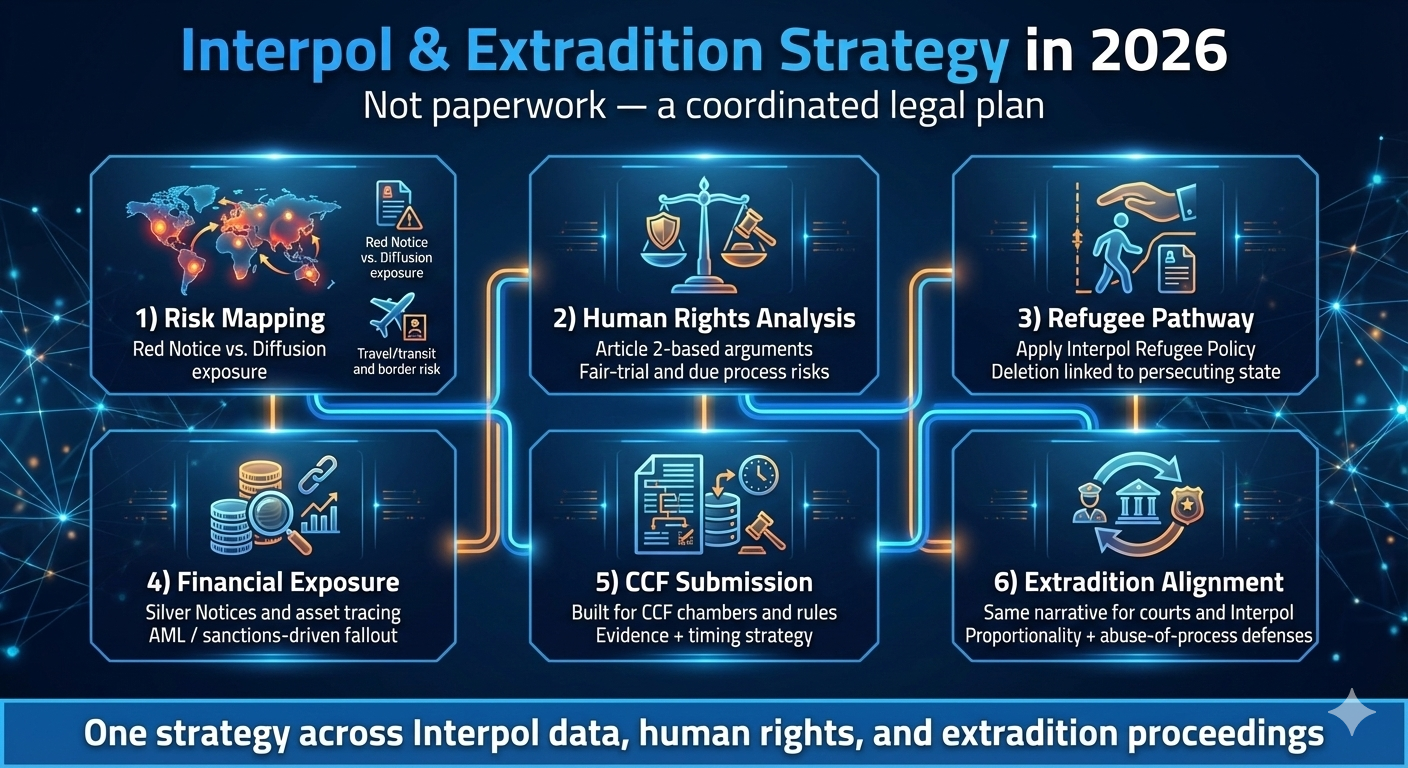
What an Interpol and Extradition Strategy Should Look Like in 2026
Clients do not need “form filling.” They need a coordinated plan that matches how Interpol and extradition actually operate.
A serious strategy typically integrates:
- Risk mapping: Red Notice vs. Diffusion exposure, travel and transit risks, border vulnerability.
- Human-rights analysis: Article 2 arguments grounded in due process, fair-trial concerns, and credible risk evidence.
- Refugee pathway assessment: where applicable, using Interpol’s Refugee Policy to pursue deletion from the persecuting country’s channel.
- Financial exposure planning: particularly where Silver Notices, asset tracing, AML de-risking, or sanctions sensitivities may be triggered.
- CCF litigation-grade submission: tailored to the CCF’s chamber structure, procedures, and timelines.
- Extradition defense alignment: ensuring Interpol strategy supports the arguments that matter in UK, US, and other court-based surrender proceedings (human rights, abuse of process, proportionality).
When to Contact an Interpol Red Notice Lawyer Immediately
You should seek advice before traveling if:
- you suspect a dispute is being turned into a criminal case abroad,
- you have political exposure, public visibility, or cross-border business conflicts,
- you have refugee status connected to the requesting state,
- a bank or compliance provider has flagged you unexpectedly,
- you have been detained, questioned, or refused boarding during transit.
For clients in the UK, the US, and globally, the difference between safety and detention is often whether counsel intervenes before a border event.
If you need a strategy built around Interpol data rules, human rights, refugee protections, and extradition defense, contact counsel via humanrights-lawyer.com.
FAQ
I am not on the Interpol website. Does this mean I am not wanted?
Not necessarily. The public “Most Wanted” list on the official Interpol website represents only a small fraction (roughly 5–10%) of all issued Red Notices. The majority of notices are confidential and are only visible to law enforcement officers and border control agencies. To find out if a “hidden” notice exists, one must submit a formal request to the Commission for the Control of Interpol’s Files (CCF).
Which is more dangerous: a Red Notice or a Diffusion?
While a Red Notice is more formal, a Diffusion (circular request) is often more dangerous due to its speed. A Diffusion is sent by one country directly to other member states, bypassing the rigorous preliminary vetting by the Interpol General Secretariat. This allows countries with authoritarian regimes to restrict a person’s movement quickly, before Interpol has had a chance to review the request for compliance with political neutrality (Article 3 of the Constitution).
Can my bank accounts be blocked because of Interpol?
Yes, and this is a major complication. Even if you are not arrested at a border, the presence of a record in Interpol’s database is picked up by bank compliance systems (via databases like World-Check). This automatically flags you as an “extremely high-risk” client. The result: frozen accounts, closure of existing accounts, and the inability to open new ones in almost any country worldwide.
What is a ‘Preventive Request’ and when should I file it?
If you anticipate that a fabricated case is being built against you in your home country and a request to Interpol is imminent, you can file a Preventive Request. This is a formal petition to the CCF providing arguments as to why a future request would violate Interpol’s rules (e.g., being politically motivated). If Interpol finds the arguments valid, it can block your data from being entered into the system before a notice is even issued.
If Interpol deletes my data, can I travel freely right away?
Not quite. After a Red Notice is removed from Interpol’s central database, the information may still linger in the national databases of individual countries. For example, if a local police force downloaded the record a month ago, they might not be aware that Interpol has since canceled the alert. After a successful deletion in Lyon (Interpol HQ), lawyers recommend sending confirmation of the deletion to the Ministries of Internal Affairs of key countries you plan to visit.
How long does the appeal and deletion process take?
The process through the Commission (CCF) is not fast. On average, a complaint takes between 9 months and 2 years to be resolved. It is important to understand that the notice usually remains active during the review period, unless you successfully apply for “interim measures” to suspend it, which is granted only in rare circumstances.
Is Interpol a ‘world police’ that can come and arrest me?
This is a common myth. Interpol has no operational officers with the power of arrest. Arrests are always carried out by the local police of the country where you are located, based on their domestic laws and international extradition treaties. A Red Notice is merely a request to local authorities to locate and provisionally arrest a person pending extradition.