



Expert ECHR Lawyers: Protection of Human Rights in Europe
When domestic legal avenues have been exhausted and your fundamental rights and freedoms are violated, the European Court of Human Rights (ECHR) in Strasbourg remains the last hope for justice. Appealing to the ECHR is a complex, multi-step legal process that requires a deep understanding of the European Convention on Human Rights (ECHR) and the extensive case law of the Court.
Our ECHR lawyers are specialists whose qualifications and experience can be decisive in the success of your case. We offer comprehensive legal support at every stage of your interaction with the European Court of Human Rights.

The ECHR, drafted in 1950 by the Council of Europe, enshrines a range of civil and political rights. It is a dynamic instrument, continually interpreted by the European Court of Human Rights (ECtHR) to address new human rights challenges. ECHR lawyers must stay abreast of these evolving interpretations and apply them effectively in various legal contexts.
Legal Representation by Expert ECHR Lawyers
Our dedicated human rights attorneys manage complex applications before the Strasbourg Court. We ensure flawless compliance with Rule 47, verify the complete exhaustion of domestic remedies, mitigate the 4-month filing deadline risks, and deliver rigorous precedent-based legal strategy to protect your fundamental rights.
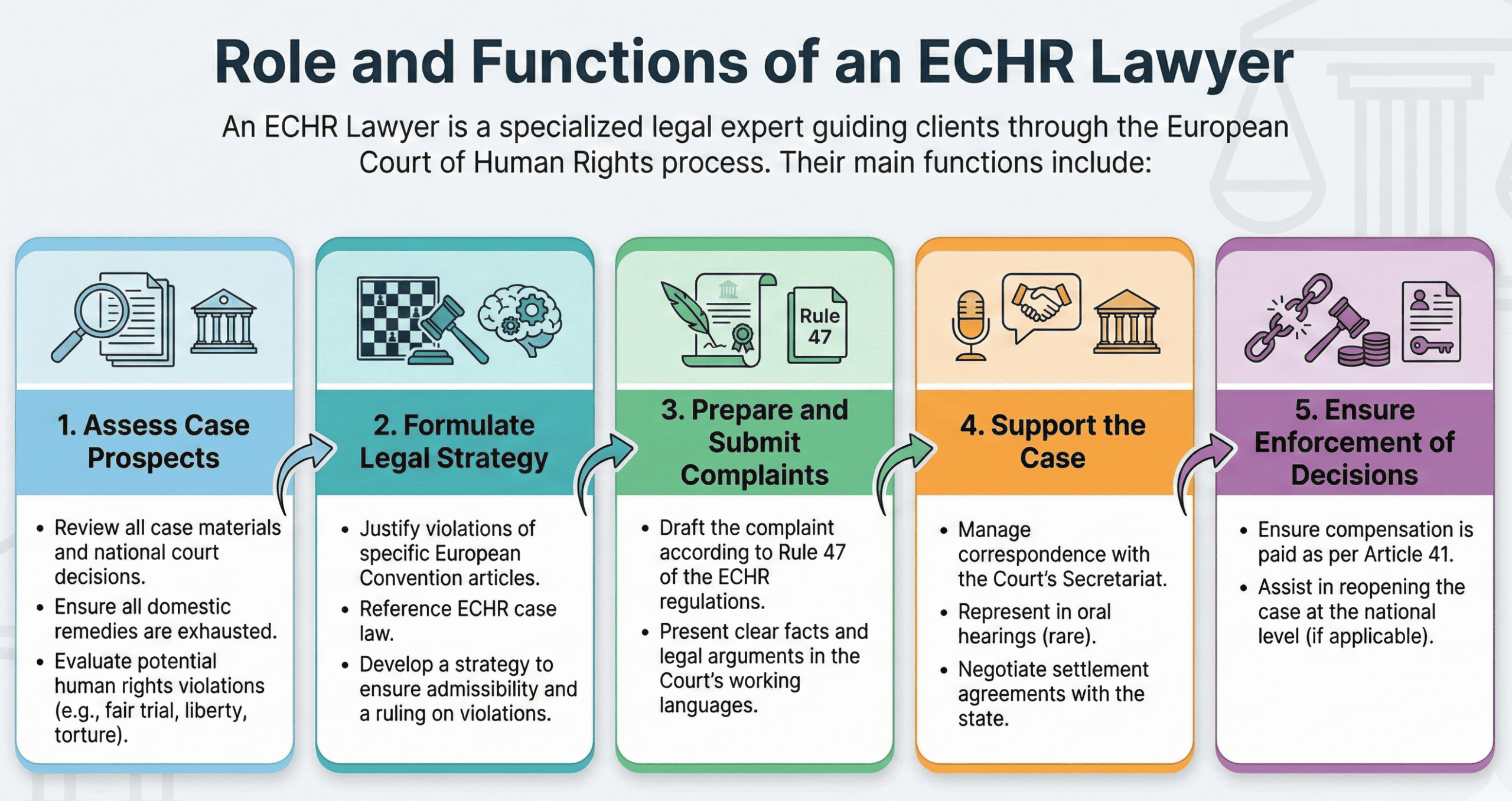
Role and Functions of an ECHR Lawyer
An ECHR lawyer is not just a regular attorney; they are specialized experts who:
- Assess Case Prospects:
They thoroughly review all materials of your case, including national court decisions and complaints at the domestic level.
They determine whether all domestic remedies have been exhausted (a mandatory requirement for the admissibility of a complaint under Article 35 of the European Convention on Human Rights).
They assess potential human rights violations, including the right to a fair trial, the right to liberty, and the prohibition of torture. - Formulate Legal Strategy:
The lawyer justifies the violation of specific articles of the European Convention on Human Rights, referencing ECHR case law.
They develop a strategy aimed at ensuring the complaint is admissible and leading to a ruling on human rights violations. - Prepare and Submit Complaints:
They prepare the complaint form in strict accordance with Rule 47 of the ECHR regulations, which is critical for initial acceptance.
They clearly, concisely, and logically present the facts and legal arguments in one of the Court’s working languages (English/French), or in a language allowed at the initial stage. - Support the Case:
They handle all further correspondence with the Court’s Secretariat, preparing additional memoranda, objections, and comments on the government’s stance.
They represent your interests in oral hearings (though these are rare).
They work on settlement agreements with the state (if advisable). - Ensure the Enforcement of Decisions:
They ensure the payment of any compensation awarded by the Court as per Article 41 of the European Convention on Human Rights.
In some cases, they assist in the process of reopening the case at the national level based on new developments (though the ECHR does not have direct authority to overturn national decisions).
Important to know: A large number of complaints (up to 90% by some estimates) are deemed inadmissible due to procedural errors, missed deadlines (4 months from the final national decision according to Article 35, paragraph 1), or incorrect legal justification. Working with an ECHR lawyer minimizes this risk.
Issues and Challenges in ECHR Cases
Appealing to Strasbourg is not just about filing a complaint. It is a battle against systemic challenges that can impact the final result.
For a claimant who has already lost a case at the national level, not only must they prove their case, but they must also overcome global and institutional difficulties inherent in international justice.
Overload and Long Waiting Times
The European Court of Human Rights faces a massive influx of complaints, leading to significant delays in case reviews. The average time for a case to be reviewed can range from 3 to 7 years, particularly in the early stages. Your appeal is just one of tens of thousands of pending cases.
- Problem: A person may wait years for justice, requiring regular monitoring and timely responses to Secretariat requests.
- Solution: ECHR Lawyers ensure a precise and complete submission of the complaint from the start, avoiding delays caused by addressing formal errors.
Strict Admissibility Criteria (Court’s Filter)
The ECHR is a court of subsidiary jurisdiction, and only a small proportion of submitted complaints are deemed admissible. It is not a fourth instance for correcting national judicial decisions, but a tool for assessing whether a state has violated the European Convention on Human Rights.
Key challenges:
- Exhaustion of domestic remedies.
- Adherence to the 4-month filing deadline.
- Clear evidence of a violation of a Convention right.
- The human rights violation must be serious enough to warrant review.
Precedent Law and Margin of Appreciation Doctrine
ECHR decisions are based on a dynamic body of precedent. Success depends on the lawyer’s ability to refer to relevant precedents and convincingly demonstrate that the facts of the case fit within the evolving interpretation of the European Convention on Human Rights.
Challenges: The Court uses the “margin of appreciation” doctrine, which allows states a certain degree of discretion in fulfilling their obligations. A successful lawyer must argue that the state has exceeded this margin and violated the complainant’s rights.
The Problem of Enforcement
Although ECHR rulings are binding on states parties (Article 46 of the European Convention on Human Rights), the enforcement process — particularly the payment of compensation and the implementation of general measures to prevent future violations — is overseen by the Committee of Ministers of the Council of Europe and can be lengthy and complicated.
Problem: Even after winning, the claimant may need assistance to ensure timely and full compensation, as well as measures to eliminate the systemic causes of the violation.
Solution: ECHR Lawyers provide support during the enforcement stage, liaising with relevant state authorities and tracking the process in the Committee of Ministers.
Self-Representation vs. Representation by ECHR Lawyers: A Comparative Analysis
Choosing between self-representation and hiring professionals is a decision that impacts the outcome of your case.
| Criterion | Self-Representation | ECHR Lawyers |
| Knowledge of Precedent Law | Superficial, difficulty in searching and analyzing relevant ECHR rulings. | Deep and up-to-date, understanding the nuances of Convention interpretation. |
| Adherence to Procedure (Rule 47) | High risk of errors in filing, missing deadlines, improper documentation. | Guarantee of strict adherence to all formal requirements of the ECHR regulations. |
| Legal Justification | Difficulty in properly framing and arguing violations of Convention articles. | Clear legal justification, focusing on violations of specific rights with reference to ECHR practice. |
| Language Barrier | Difficulty with correspondence in English/French at later stages. | Fluent in the Court’s working languages, professional translation and communication. |
| Timeframe | Risk of delays due to formal defects. | Accelerates the process with properly filed and complete documents. |
| Likelihood of Success | Low (statistically high inadmissibility). | Significantly higher (professional preparation and case handling). |
Get Professional Legal Assistance
Your right to justice should not be lost due to errors in filing!
Need an initial assessment? We will evaluate your case and provide a professional opinion on the chances of appeal to the European Court of Human Rights.
About to miss the filing deadline? Don’t waste valuable time — contact us immediately.
Book a Consultation
Free Initial Case Review
We will review your primary documents and assess whether your case meets the admissibility criteria for the European Court of Human Rights.
How to Choose Your ECHR Lawyer: 5 Criteria for Professionalism
Choosing a human rights attorney is crucial. Consider the following criteria when making your decision:
-
Experience in Strasbourg: Not just knowledge of the European Convention on Human Rights, but actual experience filing and handling cases that have resulted in communication or ECHR rulings.
-
Knowledge of the Rules (Rule 47): Ability to prepare a complaint that passes the Court’s initial admissibility filter on the first attempt, without needing to fix formal errors.
-
Specialization by Articles: Check if the lawyer has worked on violations of specific articles of the European Convention on Human Rights relevant to your case.
-
Financial Transparency: Clear breakdown of costs: fixed fee for complaint preparation and a success fee from the compensation awarded by the Court.
-
Language Competence: Fluent communication with the Court’s Secretariat in the Court’s working languages (English/French) for efficient and accurate communication.
Examples of Violations We Handle: Our Expertise in Convention Articles
Our ECHR Lawyers have extensive experience working with all key human rights violations guaranteed by the European Convention on Human Rights and its Protocols. We are ready to assist you in cases related to the following articles:
| Article of the Convention/Protocol | Right | Typical Violation |
|---|---|---|
| Article 2 | Right to life | Ineffective investigation of fatal incidents (e.g., death caused by police actions or in detention facilities). |
| Article 3 | Prohibition of torture | Inadequate detention conditions; cruel, inhuman, or degrading treatment; lack of effective investigation into such claims. |
| Article 5 | Right to liberty and security | Unlawful or arbitrary detention; unjustified prolonged detention before trial; failure to follow arrest procedures. |
| Article 6 | Right to a fair trial | Unjustified delay in judicial proceedings; lack of access to an independent court; violation of the adversarial principle; unfair trial outcomes. |
| Article 7 | No punishment without law | Application of retroactive criminal laws that worsen the individual’s situation; punishment for an act that was not a crime at the time it was committed. |
| Article 8 | Right to respect for private and family life | Unauthorized phone tapping; unlawful interference with private life; denial or difficulty in establishing paternity; issues related to gender identity and recognition. |
| Article 9 | Freedom of thought, conscience, and religion | Unjustified restrictions on religious practices; ban on wearing religious symbols in educational institutions or workplaces. |
| Article 10 | Freedom of expression | Unjustified prosecution for criticizing authorities; censorship; blocking of websites or media outlets. |
| Article 11 | Freedom of assembly and association | Unjustified ban on peaceful rallies and demonstrations; unlawful dissolution or refusal to register public organizations. |
| Article 13 | Right to an effective remedy | Lack of an effective remedy or compensation at the national level for a violation of rights guaranteed by the European Convention on Human Rights. |
| Article 14 | Prohibition of discrimination | Discriminatory application of rights guaranteed by the European Convention on Human Rights based on gender, race, religion, nationality, etc. (applies only in conjunction with another article). |
| Article 1 of Protocol 1 | Protection of property | Unlawful confiscation; non-payment of debts by the state; expropriation of property for public purposes without proper and timely compensation. |
| Article 2 of Protocol 1 | Right to education | Denial of access to education; discrimination in the education process. |
We’ve made the process of appealing to the European Court of Human Rights as transparent and understandable as possible:
| Step | Name | What Happens |
|---|---|---|
| Step 1 | Initial Assessment (Free) | You provide documents. We assess the 4-month filing deadline and exhaustion of domestic remedies. |
| Step 2 | In-depth Consultation and Contract | Detailed case analysis, identification of relevant Convention articles, contract signing, and agreement on fees. |
| Step 3 | Preparation and Submission of Complaint | Draft the complaint form (Rule 47) in the working language of the ECHR and submit it to Strasbourg. |
| Step 4 | Monitoring and Communication | Handle correspondence, respond to requests, inform you about case number assignment and communication to the government. |
| Step 5 | Enforcement of Judgment | Monitor the timely payment of compensation awarded and ensure the state implements general measures. |

Frequently Asked Questions (FAQ) about ECHR Lawyers
The ECHR protects rights listed in the European Convention on Human Rights and its Protocols, including the right to life, prohibition of torture, freedom from slavery, right to liberty and personal security, right to a fair trial (Article 6), respect for private and family life, freedom of thought, conscience, and religion, freedom of expression, and more.
No. According to Article 35, paragraph 1 of the European Convention on Human Rights, a complaint is only admissible after all domestic remedies have been exhausted.
As of February 1, 2022, the deadline is four months (previously six) from the date of the final national decision. Failing to meet this deadline will render the complaint inadmissible.
The ECHR can establish a violation of the European Convention on Human Rights by the defendant state and award the complainant fair compensation for moral and/or material damages, as well as reimbursement of legal costs.
No. The ECHR only reviews complaints against states that are parties to the Convention.
The cost of legal services in the ECHR is not fixed and usually depends on the complexity of the case (e.g., challenging extradition vs. challenging the duration of proceedings), the stage of the process (complaint preparation, correspondence with the government, oral hearings), and the amount of work involved. A combined system is often used: a fixed fee for preparing the complaint plus a success fee, which is a percentage of the compensation awarded by the Court (according to Rule 60 of the Regulations). We provide a detailed estimate after the initial analysis of your case.
The ECHR does not provide free legal aid at the complaint submission stage or before communication to the respondent government. Assistance can only be provided by the Court after the complaint has been deemed admissible and communicated to the state. This aid is intended to cover the costs of an attorney handling the case at the memorandum exchange stage. Until then, the applicant bears the cost of the attorney.
The communication of the complaint is the official notification to the respondent government (the state) that the Court has accepted the complaint for review and asks the government to submit its written observations on the case. This is a key stage that means the Court has not rejected your complaint as inadmissible due to formal issues (such as time limits or format). It confirms that ECHR Lawyers have successfully passed the initial “admissibility filter”.
If a state is excluded or voluntarily leaves the Council of Europe, the ECHR can continue to review complaints filed against that state for violations that occurred before the date its membership in the Convention ended. However, enforcing judgments in such cases becomes a more complex process controlled by the states that remain party to the Convention. ECHR Lawyers will help assess the legal status of your case in light of the latest international rulings.
In the context of criminal proceedings, “exhaustion of domestic remedies” means that you must have exhausted all available and effective judicial avenues in your case — at least the appellate and cassation instances (or their equivalents). If you did not use the opportunity to appeal as provided by national law, or if you missed deadlines, the ECHR will deem the complaint inadmissible for non-exhaustion. Our lawyers carefully verify compliance with this requirement.